Sahara
The ForgivenThe Sahara in the novel is more than a remote backdrop: its terrain organizes travel, labor, and the encounters between local communities and foreign visitors. Around Azna, the desert is at once a harsh environment and a source of livelihood, marked by ruined settlements, scarce water, and fossil-bearing ground. Its scale also unsettles the people who cross it, exposing the limits of their assumptions about where they are and what they can control.
Setting and Landscape
Near Tafnet, the ruined ksour of Azna stands high on a hillside, its dark-brown main mansion and four-hundred-year-old granaries built of earth. The settlement has been abandoned since Moroccan independence in 1956. It lies near a natural spring once named La Source des Poissons by the Foreign Legion, whose water is associated with a local belief about fertility. A river curves around the cliffs, and steps descend from the houses to a pool where women of the Aït Atta are said to recuperate in secret. The spring and pool make water a focus of life and tradition in a setting otherwise defined by aridity.
The landscape around Azna is described through stark contrasts in color, texture, and scale. From the ksour, tawny slopes dotted with date palms descend toward pale plains; above them rise rounded, boulder-strewn peaks. Vegetation is sparse, with prickly pear and small yellow flowers among the rocks. The mud-built settlement seems to rise from the earth itself, while a neighboring ksour clings to an equally inhospitable mountainside. The terrain is not merely scenery for visitors: its exposure and difficulty make the choice to build a holiday home there appear audacious.
Heat shapes the rhythms of life in this landscape. At an hour past sunset, the temperature around a gathering at the remote house remains above 104 degrees. The desert has a different aspect at dusk: dust advances toward the cliffs and tents, a wild camel noses along the dark road, and an orange light gathers at the valley’s opening. Such scenes place human activity within a landscape whose shifts continue independently of the visitors’ plans.
Water, Visitors, and the Desert House
The desert setting brings foreign visitors into contact with local customs while keeping them visibly apart. The people of Azna call them les visiteurs: wealthy outsiders who are expected eventually to leave. They employ local staff and spend freely, but their habits seem strange to the community. They cannot drink the local water, swim naked in their own pool, and sometimes enter the pools at La Source des Poissons, raising local concerns about the spring. The visitors’ private pool offers a controlled substitute for the water around them, even as their use of the natural pools intrudes on a place of local significance.
The house also becomes a stage for a gathering shaped by the desert’s distance from ordinary urban life. Guests arrive from far away for the promise of adventure and wealth; musicians perform, and the hosts lead the applause before dinner. The heat sends some of the women toward the pool, while Tom Day surveys the guests and feels both a kinship with and distance from their metropolitan world. The episode presents the desert as a destination sought by outsiders, but not one they necessarily understand. Their presence brings money and employment, while their assumptions and habits mark the unequal terms of their arrival.
Fossil Work and the Costs of Survival
For local people, the desert is also a workplace. A police captain reminds David Henniger that people may be desperate enough to sell a single trilobite for forty euros, a sum that matters to them. The exchange makes visible the economic disparity between visitors able to travel and spend and residents who depend on the sale of fossils. The desert’s geological past has become a resource in the present, though the benefits of that resource are not shared equally.
Driss’s memories trace this work back to childhood. At ten, he was made to climb cliff faces with hammers and chisels, extracting trilobites from the rock over long working days. His father’s demands framed labor as a test of obedience and usefulness. From the cliffs he could see the desert, houses, graveyard, riverbed, and oasis, and he already felt resentment toward the place he called home. The account connects fossil extraction not to romantic adventure but to hard labor, family pressure, and a desire to look beyond the horizon.
The seasonal economy intensifies this sense of constraint. When November rains arrive, tourists disappear; the Bloodworths close part of their house and retreat to heated rooms, while Driss becomes increasingly impatient. His thoughts turn to Paris, and he asks Roger Bloodworth about roads leading north through the mountains into France. He knows such routes are expensive, but hopes he might find a ride with Moroccans traveling from Algeciras. The contrast is sharp: visitors can treat the desert as a seasonal retreat, while a local worker sees departure as a difficult possibility.
Routes, Scale, and Narrative Significance
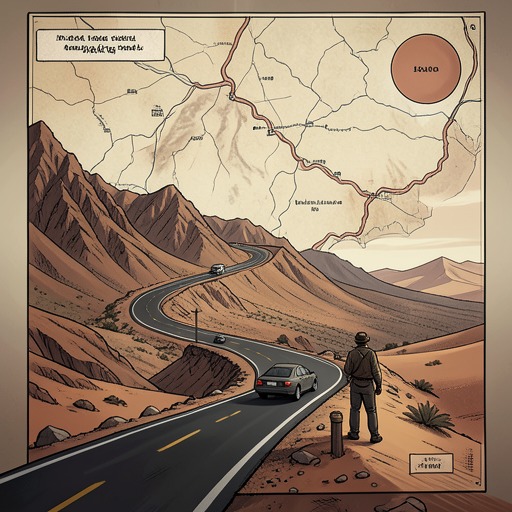
The journey toward Tafal’aalt carries the desert from an inhabited margin into a vast, difficult expanse. The track grows faint as acacias multiply, their thorns scattered over the ground. Atchana, whose name means the thirsty one in Arabic, marks the edge of the plateau of the Jbel Issomour massif near the Algerian border. The ground becomes dark, cracked, and jagged, and the vehicle leaves the recognizable road to cross open country. Fossil trenches cut into the land, with workers’ tools and camping gear left in place during the hot season and reclaimed when cooler weather returns. The equipment’s long absence gives the worksite the appearance of a camp temporarily emptied rather than abandoned.
The plateau’s openness does not make travel easy. The Toyota strains up serpentine gullies, and the water in the bottles grows hot. From the high ground, the travelers can see desert expanses in pale colors, while more trenches and tool bags show that fossil work continues even in this severe terrain. Their route then descends toward villages on the mountain’s north face, including La’gaaft and Tafal’aalt. The sequence makes the landscape a force in the journey: distance, heat, rough ground, and the sparse road determine how the travelers move and what they encounter.
The Sahara also magnifies David’s uncertainty. As he travels with Abdellah and the others, the remote borderland prompts him to imagine danger and to recall news of violence near oil installations in Mauritania. His fears reveal how readily he interprets unfamiliar terrain through suspicion, even as the journey places him among people whose own lives and work are shaped by the same landscape. The desert therefore carries more than geographical distance. It exposes a divide between the visitor’s expectations and the material realities of those who live and labor there, while its roads and fossil trenches bind the novel’s questions of travel, poverty, and responsibility to the land itself.